


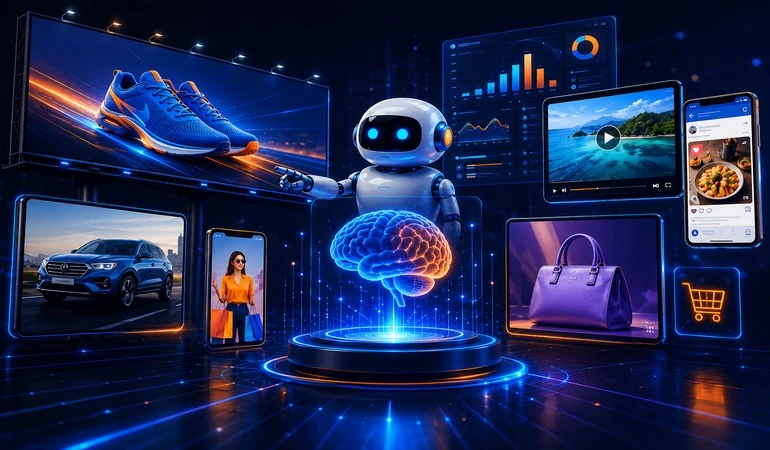

Digital advertising today has become far smarter than it used to be. In the past, companies ran ads based largely on guesswork, but Artificial Intelligence (AI) has completely transformed display advertising. It is now easier than ever to show the right ad to the right person at the right time.
If your business aims to reach online customers, simply running display ads isn't enough; you also need to understand the latest trends in AI-driven display advertising. These trends help you utilize your advertising budget more effectively, generate more leads & boost sales.
Why is AI Display Advertising Rapidly Gaining Popularity?
Millions of ads are displayed on the internet every day, making it difficult to capture a customer's attention.
AI addresses this challenge by analyzing vast amounts of data to understand which individuals are likely to respond to specific types of ads.
Key reasons include:
• More precise targeting
• Lower advertising costs
• Better ROI
• Faster campaign optimization
• Improved customer experience
AI Display Advertising Trends Every Business Should Know
1. Smart Audience Targeting
AI no longer relies solely on age & location for targeting.
It analyzes customer behavior, purchasing habits, search history, device usage & online activities.
This ensures that ads reach the people most likely to make a purchase.
Benefits
• Reduced Ad Waste
• Better Conversion Rate
• More Qualified Leads
2. Predictive Advertising
AI can predict which customers are likely to purchase in the future.
Machine Learning identifies potential customers by analyzing past data.
This allows businesses to target the right customers proactively.
3. Dynamic Creative Optimization (DCO)
Not every customer is the same.
AI creates different ads for different users.
For example:
• Different Image
• Different Headline
• Different CTA
• Different Offer
This makes ads feel more personalized.
4. Real-Time Campaign Optimization
Campaign optimization used to take days.
Now, AI analyzes campaign performance every second.
If an ad isn't performing well, AI can automatically:
• Change the budget
• Adjust the bid
• Change the creative
• Change the audience
5. Smart Bidding
Manual bidding is gradually becoming less common.
AI-based Smart Bidding considers factors such as:
• Device
• Time
• Location
• User Intent
• Previous Behavior
This improves the quality of every click.
6. Hyper-Personalization
Today, customers prefer seeing ads relevant to their needs.
Through AI-driven personalization, it delivers:
• Product Recommendations
• Personalized Offers
• Customized Display Ads
• Individualized Messaging
This enhances the customer experience.
7. Privacy-First Advertising
Third-party cookies are gradually being phased out.
AI is now increasingly utilizing first-party data.
This ensures:
• User privacy is maintained.
• Better audience segmentation.
• Easier regulatory compliance.
8. Growing Use of Contextual Targeting
AI no longer relies solely on user data.
It understands website content & displays relevant ads based on it.
Example:
If someone is reading a fitness blog, they might see ads for gym equipment, protein supplements or health products.
9. AI-based Fraud Detection
Fake clicks are a major issue in digital advertising.
AI can now easily identify:
• Invalid clicks
• Bot traffic
• Fake impressions
• Click fraud
This helps safeguard the advertising budget.
10. AI-Generated Ad Creatives
AI now goes beyond just targeting; it also assists in creating ad content.
AI can generate:
• Banner headlines
• Product descriptions
• Display image suggestions
• CTA variations
• Multiple ad versions
This saves time for the marketing team.
Key Benefits of AI Display Advertising
AI-based display advertising benefits businesses on multiple levels.
• Better ROI
• Higher conversions
• Lower Cost Per Click (CPC)
• Faster optimization
• Improved customer experience
• Automated decision-making
• Campaign scalability
• Increased revenue
Which businesses should adopt AI display advertising?
Almost every industry can benefit from it.
• E-commerce
• Healthcare
• Education
• Real Estate
• Travel
• Finance
• SaaS
• Retail
• Automotive
• Hospitality
Use Case 1: AI Display Advertising for an E-commerce Store
An online clothing store was displaying identical advertisements to all its customers. Sales were lower than expected.
After implementing an AI-based display campaign:
• Customer purchase history was analyzed.
• Tailored ad creatives were displayed for different age groups.
• Remarketing ads were shown to customers who had abandoned their shopping carts.
Results
• Significant increase in conversion rate.
• Improved cart recovery.
• Better utilization of the advertising budget.
Use Case 2: AI Display Ads for an Educational Institute
An online training institute wanted to increase student enrollments.
AI:
• Displayed ads on career-related websites.
• Promoted specific courses based on student interests.
• Increased the campaign budget during exam seasons.
Results
• Increase in qualified leads.
• Reduced cost of admission.
• Improved enrollment rate.
Case Study 1: Remarketing Success for an E-commerce Brand
A mid-sized e-commerce brand was receiving good website traffic, but most visitors were leaving without making a purchase.
The company adopted AI-based display remarketing. The AI analyzed user browsing behavior, viewed products & purchase probability. Based on this, personalized ads were shown to each user according to their interests.
Results
• Increased number of returning visitors.
• Clear improvement in purchase conversions.
• Reduced advertising cost per sale.
• Increased likelihood of repeat purchases.
Case Study 2: Healthcare Service Provider
A healthcare service provider was promoting its diagnostic packages & online appointment services. Traditional display ads were yielding limited results.
After implementing an AI-based campaign, the platform analyzed patients' search interests, location, timing & interest in health-related topics. Highly relevant ads were displayed based on these insights.
Results
• Significant increase in appointment bookings.
• Reduced cost per lead.
• Improved click-through rate due to increased ad relevance. The marketing budget was utilized more effectively.
Key Considerations for Implementing AI Display Advertising
Keep a few important points in mind for a successful campaign.
• Define clear campaign goals.
• Use high-quality first-party data.
• Test various creatives.
• Ensure accurate conversion tracking.
• Conduct regular performance analysis.
• Comply with privacy regulations.
• Periodically review AI suggestions.
The Future of AI Display Advertising
AI display advertising is set to become even more advanced in the coming years. We may see the following changes in the future:
• Highly personalized ads
• Voice & visual search-based ads
• Predictive customer journeys
• Automated creative generation
• Cookieless advertising
• Improved cross-device targeting
• Real-time personalization
Businesses that adopt these technologies early will stay ahead of the competition.
FAQs
AI display advertising uses artificial intelligence to enhance ad targeting, bidding, creative optimization & campaign performance.
Yes. Small businesses can reach the right audience & achieve better ROI, even with a limited budget.
The biggest benefits are improved targeting, reduced ad spend & higher conversion rates.
No. AI assists with decision-making & campaign optimization, but human experts remain crucial for strategy, brand messaging & creative thinking.
In the future, AI-based advertising will be more personalized, privacy-friendly, automated & data-driven, enabling businesses to deliver better customer experiences & achieve more effective marketing results.
