


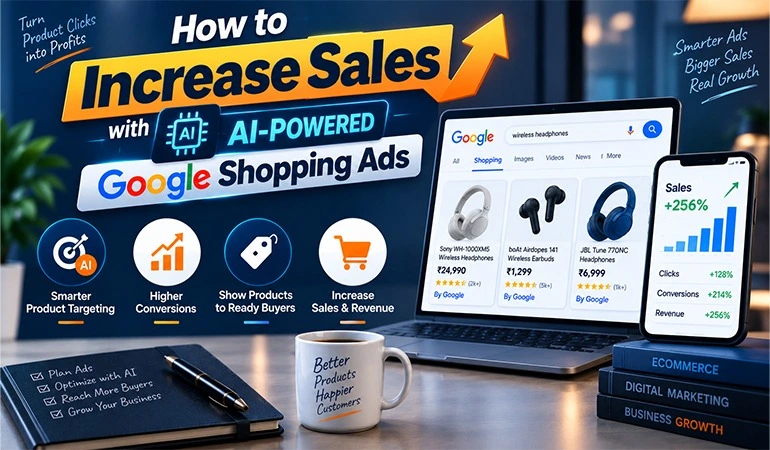

In today's world, having a good product isn't enough for online shopping. Delivering the right product to the customer at the right time is equally important. This is where Google Shopping Ads and Artificial Intelligence (AI) come into play.
Google Shopping Ads showcase your products in Google Search with an image, price, product name and store information. This gives customers basic product information before clicking.
When combined with AI-powered targeting bidding product analysis and customer behavior data advertising can be managed more intelligently. DigiTech Media Network helps businesses create strategies that focus Shopping Ads more on sales rather than just driving traffic.
Why can Google Shopping Ads increase sales?
The biggest advantage of Shopping Ads is that the customer can visually see the product. If someone wants to buy shoes and searches "running shoes for men" on Google, they may see several products with images and prices.
The customer receives initial information about the product upfront. This provides an opportunity to reduce irrelevant clicks and reach users with purchase intent.
AI helps further improve this process. It can continuously analyze campaign data to optimize bidding and targeting decisions.
How does AI optimize Google Shopping campaigns?
Use Smart Bidding
Manual bidding may require repeated adjustments of bids for each product or audience. AI-based Smart Bidding helps adjust bids based on historical and real-time signals.
If a user is more likely to buy the system can place a more competitive bid in that auction.
Focus on High-Converting Products
Not every product generates the same sales. Some products generate more clicks, while others generate more purchases.
With AI and conversion data businesses can identify products with better sales potential.
Distributing budgets appropriately across these products can improve campaign efficiency.
Keep the Product Feed Right
Google Shopping campaign performance largely depends on the quality of the product feed.
Product title description, image price availability and product category should be accurate and updated.
Include relevant search terms naturally in product titles.
Improve Product Images
Images in Shopping Ads create a customer's first visual impression. Clear high-quality and product-focused images appear more professional.
Minimize unnecessary elements in images and keep the product clearly visible.
Get Conversion Tracking Right
AI needs reliable data to make good decisions. If purchase tracking is inaccurate, campaign optimization can be affected.
Therefore it's important to properly set up tracking of purchases, revenue add-to-cart and other relevant actions.
What strategies work in AI-powered Shopping Ads?
A good shopping strategy isn't limited to just launching a campaign. It's essential to continuously review campaign data and extract actionable insights from it.
DigiTech Media Network can take a different approach to analyzing campaign performance, such as:
* Which products are generating more revenue?
* Which products are getting more clicks but fewer sales?
* Which search terms are driving more valuable customers?
* Which devices are driving more purchases?
* Which audiences have better conversion rates?
* Which products are consuming the advertising budget?
Based on these insights changes can be made to budget product selection and campaign strategy.
Use Case 1: Fashion E-commerce Store
Suppose an online fashion store has over 500 products. It's not necessary to allocate the same budget to all products.
AI-based campaign data may reveal that specific categories such as men's sneakers and women's ethnic wear are generating more purchases than other products.
Businesses can prioritize these high-performing products and revise product feeds, pricing images or targeting weaker products.
This approach can help direct advertising budgets to more productive products.
Use Case 2: Electronics Store
An electronics store sells smart phones, head phones, smart watches and accessories.
Campaign data shows that smart phones have higher clicks but accessories have better profit margins. In this situation looking at sales volume alone isn't enough.
AI-driven analysis can help develop a bidding and budget strategy by considering product performance conversion value and customer behavior together.
This helps businesses focus on profitability along with revenue.
Case Study 1: Online Apparel Brand
An online apparel brand was receiving traffic through Google Shopping Ads, but despite clicks on many products purchases were low.
A campaign review revealed the need for improvements to product titles, images and product feed information. The bidding strategy was also refined by prioritizing high-performing products.
The campaign's focus was then shifted from clicks to conversion value and purchase intent.
In this way AI-based optimization was used to improve advertising decisions based on customer signals and product performance.
Case Study 2: Consumer Electronics Business
A consumer electronics business was advertising several products on Google Shopping. Some products were consistently generating a budget but their conversion performance was weak.
Analyzing the campaign data revealed a clear distinction between better-performing and weaker products.
The business focused on improving the product feed, reviewing low-performing listings and optimizing the bidding strategy for high-value products.
This made campaign management more data-driven and provided an opportunity to redirect advertising budget towards better-performing products.
Common Mistakes in AI Shopping Ads
Relying solely on AI and leaving campaigns unmonitored is not the right approach. AI makes decisions based on available data so the quality of the input data is crucial.
Some common mistakes are:
* Incorrect conversion tracking
* Poor product feed
* Outdated product prices
* Low-quality product images
* Irrelevant product titles
* Applying the same budget to all products
* Frequent changes without devoting sufficient time to campaign data
* Considering only clicks as a measure of success
How does DigiTech Media Network help with AI-powered Google Shopping Ads?
DigiTech Media Network focuses on helping businesses plan their Google Shopping strategy based on business goals and product performance.
This can include areas such as product feed optimization campaign setup, conversion tracking bidding strategy and performance analysis.
The proper use of AI helps make campaigns more data-driven. However, the final strategy should be developed taking into account the business's products, margins, competition and customer behavior.
How to measure Google Shopping Ads performance?
Simply looking at impressions and clicks isn't enough to increase sales. Campaigns should be evaluated based on business value.
Important metrics include:
* Conversion Rate
* Conversion Value
* Cost Per Conversion
* Return on Ad Spend (ROAS)
* Click-Through Rate
* Average Order Value
* Product-level revenue
Looking at these metrics together helps understand how much sales value an advertising budget is actually generating
FAQs
Yes. Even small businesses can utilize AI-based bidding and optimization features. With the right product feed, conversion tracking and sufficient campaign data, AI can help make better advertising decisions.
Relying on a single factor is not ideal. Product feed quality, competitive pricing, good product images, accurate conversion tracking and the right bidding strategy all impact campaign performance.
AI can help analyze product performance and conversion signals based on campaign data. However businesses should make final decisions based on factors such as profit margin inventory and product demand.
ROAS helps you understand how much conversion value is generated from advertising money spent. This helps businesses evaluate how financially effective a campaign is.
DigiTech Media Network can support businesses in areas such as Shopping campaign planning, product feed optimization conversion tracking bidding strategy and campaign performance analysis. With the right strategy campaigns can be optimized to meet sales and revenue goals.
