



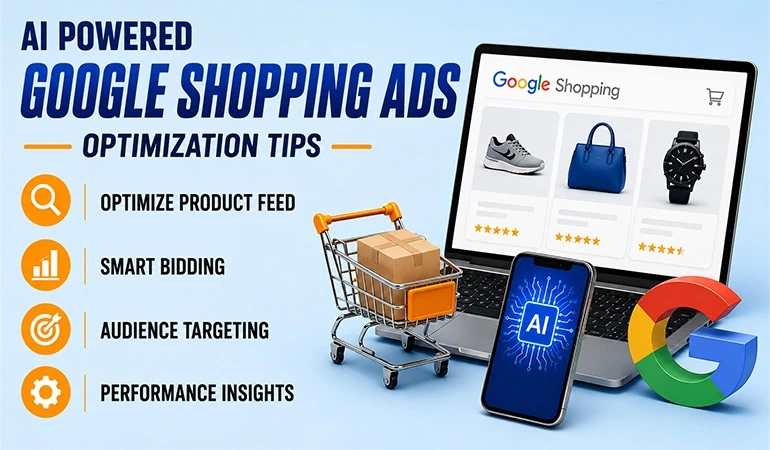
Google Shopping Ads have become an important sales channel for e-commerce businesses. They place products directly in front of people who are already searching for something they want to buy.
However, running Shopping Ads successfully requires more than uploading a product feed and increasing the budget. Product titles, pricing, images, bidding, audience signals, search queries and conversion data all influence campaign performance.
Artificial intelligence is making this process more efficient. AI can identify patterns across large amounts of campaign data, spot weak products, improve targeting decisions and help advertisers spend their budget more carefully.
For businesses working with DigiTech Media Network, understanding how AI can support Google Shopping optimization can make campaign management more structured and data-driven.
What Are AI Powered Google Shopping Ads?
AI powered Google Shopping Ads use machine learning and automated systems to improve how products are matched with potential customers.
Google's advertising systems analyse signals such as:
• Search intent
• Product information
• Device and location
• Previous interactions
• Purchase behaviour
• Conversion history
• Product price and availability
• Audience signals
This information helps Google decide when a product should appear and how much an advertiser should bid for a potential customer.
The advertiser's job is to provide accurate product data, strong creative assets, suitable conversion tracking and enough quality data for the system to learn.
Why AI Matters for Google Shopping Campaigns
Traditional campaign management often involves manually reviewing search terms, bids, products and performance reports. This can become difficult when an online store has hundreds or thousands of products.
AI can process this information much faster and identify relationships that may be difficult to notice manually.
Some major advantages include:
• Faster campaign analysis
• Better budget allocation
• Improved product targeting
• More accurate bidding decisions
• Identification of underperforming products
• Better use of conversion data
• Reduced manual campaign management
AI should support strategic decisions rather than replace them. Poor product data or incorrect tracking can still lead to poor results.
AI Powered Google Shopping Ads Optimization Tips
1. Improve Your Product Feed
Your product feed is the foundation of a Shopping campaign. AI can only work effectively when Google receives clear and accurate product information.
Review product titles, descriptions, categories, prices, images, availability and identifiers regularly.
Include important attributes such as:
• Brand
• Product type
• Model
• Size
• Colour
• Material
• Relevant product features
Avoid stuffing unnecessary keywords into titles. Make the information useful to both shoppers and Google's systems.
2. Use AI Insights to Identify Winning Products
Do not treat every product equally.
Review which products generate clicks, conversions, revenue and healthy profit margins. AI-based analysis can help identify products with strong sales potential and products that consume budget without producing enough value.
You can then organise your campaign strategy around actual performance rather than assumptions.
3. Use Smart Bidding Carefully
Automated bidding strategies can use conversion signals to adjust bids according to the likelihood of achieving a desired result.
Depending on the campaign and business objective, advertisers may consider strategies such as:
• Maximize Conversions
• Maximize Conversion Value
• Target CPA
• Target ROAS
The right strategy depends on the quality and quantity of available conversion data. Changing bidding strategies too frequently can also make performance harder to evaluate.
4. Strengthen Conversion Tracking
AI needs reliable information.
If purchases, revenue, phone calls, or other valuable actions are not tracked correctly, Google's automated systems may optimise toward incomplete information.
Check that:
• Purchase values are recorded correctly
• Duplicate conversions are avoided
• Enhanced conversions are configured where appropriate
• Primary conversion actions reflect real business goals
• Tracking works across the customer journey
Accurate data gives automation a much stronger foundation.
5. Improve Product Images
Shopping Ads are highly visual. A strong product image can influence whether someone notices and clicks your listing.
Use clear, high-quality images that show the actual product. Avoid misleading visuals and unnecessary text overlays.
AI tools can help identify patterns in creative performance, but the final image should still meet Google's requirements and represent the product accurately.
6. Analyse Search Intent
AI can help advertisers understand which searches are producing valuable traffic.
Look beyond clicks. Examine whether particular search themes lead to purchases, high order values, or repeat customers.
Separate irrelevant traffic from commercially useful searches and refine product information accordingly.
7. Segment Products by Business Value
Revenue alone does not tell the whole story.
A product with high sales but very low margins may deserve a different advertising approach from a product with moderate sales and strong profitability.
Consider grouping products according to:
• Profit margin
• Conversion rate
• Average order value
• Stock availability
• Seasonal demand
• Customer lifetime value
This gives AI-driven bidding strategies better business context.
8. Monitor Performance Instead of Making Constant Changes
AI-powered campaigns need time and stable data.
Avoid changing budgets, bidding strategies, targeting and product groups every few days simply because performance fluctuates.
Set a review schedule and evaluate meaningful trends. Make changes when the data provides a clear reason.
Use Case 1: Fashion E-Commerce Store
Imagine an online fashion store with more than 2,000 products.
Its Shopping campaign receives plenty of traffic, but several products generate clicks without enough purchases.
An AI-assisted analysis can identify products with high spending and weak conversion performance. The marketing team can then review those products, improve their titles and images, adjust their bids, or reconsider whether they should receive the same advertising budget.
At the same time, products with strong conversion rates and healthy margins can receive greater attention.
Use Case 2: Electronics Retailer
An electronics retailer sells smartphones, accessories, laptops and smart devices.
The store notices that some products generate high revenue but produce lower returns because of aggressive competition and narrow margins.
AI-assisted campaign analysis can compare conversion value, advertising cost, product demand and bidding performance. The retailer can use these insights to prioritise products that provide better commercial value rather than simply promoting the products with the highest number of clicks.
Case Study 1: Improving an Online Apparel Campaign
An apparel business was receiving substantial Shopping traffic but had inconsistent sales.
The team reviewed its product feed and discovered that many titles lacked useful details such as product type, colour and material. Images were also inconsistent across product categories.
After improving product information, standardising images and using conversion-focused bidding with cleaner tracking data, the campaign became easier to manage. The business could identify strong product categories more clearly and reduce attention on products that consistently consumed budget without sufficient returns.
The key lesson was simple: AI performs better when the information and conversion signals behind the campaign are reliable.
Case Study 2: Optimizing a Consumer Electronics Store
A consumer electronics store had a large catalogue and struggled to determine where its advertising budget was producing the strongest returns.
The marketing team analysed product-level conversion value, ROAS, search behaviour and inventory availability. AI-assisted insights helped highlight products with strong demand and better commercial potential.
The business then focused its optimisation efforts on those product groups while reviewing low-performing products separately. This created a more disciplined approach to budget allocation and reduced the need for constant manual bid adjustments.
Common Mistakes to Avoid
AI automation does not guarantee successful campaigns. Avoid these common mistakes:
• Using incomplete product feeds
• Ignoring conversion tracking errors
• Optimising only for clicks
• Promoting products with poor margins
• Changing strategies too frequently
• Ignoring product availability
• Using misleading product images
• Setting unrealistic ROAS targets
• Treating every product as equally valuable
How DigiTech Media Network Can Help
Google Shopping optimisation requires a combination of technical accuracy, product understanding, campaign analysis and continuous monitoring.
DigitechMediaNetwork can help businesses build a structured approach to Google Ads, from campaign planning and conversion tracking to product feed optimisation and performance analysis.
The goal should be to make advertising decisions based on useful business data rather than isolated metrics such as impressions or clicks.
FAQs
Yes. Google uses machine learning in several automated bidding and campaign systems. However, advertisers still need to provide accurate product data, conversion tracking, suitable targets and proper campaign inputs.
There is no single factor. Product feed quality, conversion tracking, product relevance, bidding strategy, pricing, images and landing page experience all influence performance.
Not always. Automated bidding works best when Google has sufficient reliable conversion data. New or low-volume campaigns may require a different approach while enough data is collected.
Campaigns should be monitored regularly, but major changes should be based on meaningful performance data. Making frequent changes without enough data can make it difficult to understand what actually improved results.
Yes. Better product data, stronger conversion tracking, improved targeting signals and smarter budget allocation can improve campaign efficiency without necessarily increasing the total budget.
