


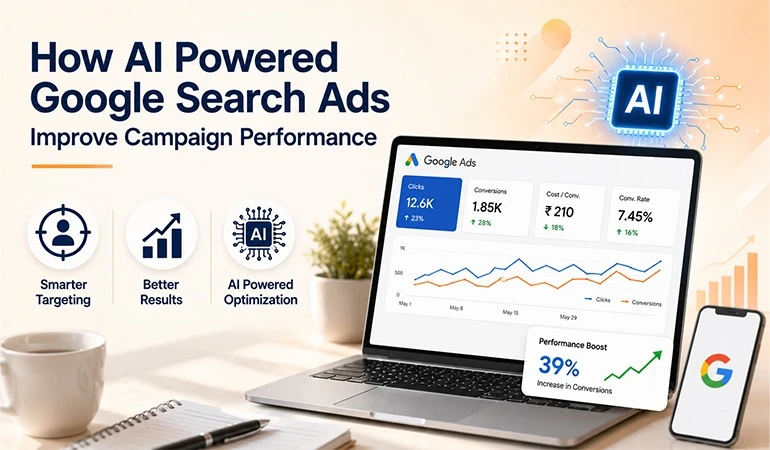

Google Search Ads have always been an effective way for businesses to reach people who are actively searching for products and services. With artificial intelligence now becoming a major part of Google Ads, campaigns can analyse large amounts of data, identify useful patterns & make faster optimisation decisions.
AI powered Google Search Ads can help advertisers improve targeting, bidding, ad relevance & budget allocation. For businesses working with competitive keywords, these improvements can make a meaningful difference in both traffic quality and campaign performance.
At Digitechmedianetwork, understanding how AI works within Google Ads can help businesses build campaigns that are more focused, measurable & responsive to changing customer behaviour.
What Are AI Powered Google Search Ads?
AI powered Google Search Ads use machine learning and automated systems to analyse signals such as search queries, device type, location, time, audience behaviour & previous interactions.
Instead of relying entirely on manual campaign adjustments, Google's AI can use these signals to determine which users are more likely to take a desired action.
Some AI driven features include:
• Smart Bidding
• Responsive Search Ads
• Broad match with Smart Bidding
• Performance Max campaign signals
• Automated audience insights
• Conversion-based optimisation
These tools allow advertisers to spend less time making repetitive adjustments and more time working on strategy, messaging, landing pages & conversion goals.
How AI Improves Google Search Ads Performance
1. Smarter Keyword and Search Intent Matching
Traditional keyword targeting often depends heavily on selecting specific keywords and match types. AI can understand the meaning and intent behind searches, allowing ads to appear for relevant variations that may not have been manually added to the campaign.
AI helps Google interpret these relationships and identify searches that could bring valuable users.
2. Better Automated Bidding
Manual bidding requires continuous monitoring and adjustment. AI based bidding strategies can evaluate signals for individual auctions and adjust bids according to the likelihood of achieving a campaign goal.
Depending on the objective, advertisers can use strategies such as:
• Maximize Conversions
• Target CPA
• Maximize Conversion Value
• Target ROAS
This can help businesses use their advertising budget more efficiently, particularly when sufficient conversion data is available.
3. Improved Audience Targeting
AI can analyse user signals to identify patterns among people who are more likely to convert.
It can consider factors such as:
• Search behaviour
• Previous website interactions
• Device usage
• Geographic signals
• Time and context
• Conversion history
This allows campaigns to focus more strongly on users who show meaningful purchase or enquiry intent.
4. More Relevant Ad Combinations
Responsive Search Ads allow advertisers to provide multiple headlines and descriptions. Google's systems can then test different combinations to identify messages that perform well for different searches.
The quality of the original ad assets remains important. AI performs best when advertisers provide clear, useful & relevant messaging.
5. Faster Campaign Optimisation
Customer behaviour can change quickly. A keyword that performs well today may become less effective later because of competition, seasonality, changing demand & audience behaviour.
AI can process campaign signals continuously and make automated adjustments much faster than a person manually reviewing every campaign element.
This makes it easier for advertisers to respond to changing performance patterns.
Use Case 1: Digital Marketing Training Institute
Consider a digital marketing institute targeting students and working professionals.
The campaign may target searches such as "digital marketing course," "SEO course," "Google Ads training," and "digital marketing institute near me."
AI can analyse which searches, audiences, devices & locations are generating enquiries. With conversion tracking and an appropriate bidding strategy, the campaign can gradually focus on traffic that has a stronger likelihood of submitting an enquiry.
For Digitechmedianetwork, this approach can support campaigns where the primary objective is qualified course enquiries rather than simply increasing website visits.
Use Case 2: Local Service Business
A local service company may advertise for searches such as "AC repair near me," "emergency AC service," or "AC technician in [location]."
AI can use contextual signals to help determine which searches are more likely to produce calls or enquiry forms.
If conversion tracking is correctly configured, the campaign can optimise towards actions that matter to the business instead of treating every click as equally valuable.
Case Study 1: Improving Lead Quality for a Training Business
A hypothetical training business was receiving a large number of clicks but relatively few serious enquiries.
The campaign relied heavily on manual keyword selection and focused mainly on traffic volume. After reviewing the account, the strategy was changed to focus on conversion tracking, stronger search intent, responsive ad assets & automated bidding.
The business also refined its landing page so that the course details, eligibility, benefits & enquiry option were easier to understand.
Over time, AI had more useful conversion data to work with. The campaign could then identify patterns associated with stronger enquiries and adjust bidding accordingly.
The key lesson is that automation works best when campaign objectives, conversion tracking & landing pages are properly aligned.
Case Study 2: Improving Search Campaign Efficiency for a Local Business
A local business was spending money on search traffic from several locations, but some areas produced very few enquiries.
After implementing conversion focused bidding and reviewing geographic performance, the campaign began using available signals to place greater emphasis on searches that showed stronger conversion potential.
Ad messaging was also made more specific to the services and locations being targeted.
The result was a more focused campaign structure with better visibility into where advertising spend was producing meaningful business actions.
This illustrates an important point: AI can support campaign optimisation, but accurate data remains essential for making good decisions.
Why Conversion Tracking Matters in AI Campaigns
AI needs reliable signals to optimise effectively. If Google Ads is told that every page visit is a conversion, the system may optimise towards users who generate visits rather than users who generate enquiries or sales.
Businesses should carefully define valuable conversions, such as:
• Completed enquiry forms
• Phone calls
• Course registrations
• Product purchases
• Appointment bookings
• Qualified leads
Proper conversion tracking gives Google's systems a clearer objective and helps advertisers evaluate actual business performance.
How Businesses Can Get Better Results from AI Powered Ads
AI does not remove the need for human strategy. Advertisers still need to make important decisions about positioning, offers, keywords, landing pages, budgets & customer intent.
For better results:
• Set clear campaign goals.
• Track meaningful conversions.
• Write several strong ad assets.
• Keep landing pages relevant to search intent.
• Review search terms regularly.
• Use negative keywords where appropriate.
• Give automated bidding enough quality data.
• Monitor cost per lead and lead quality.
• Test different offers and messaging.
• Avoid making frequent changes without sufficient data.
Role of Digitechmedianetwork in AI Driven Google Ads
Digitechmedianetwork can help businesses understand how paid search fits into their broader digital marketing strategy.
A successful Google Ads campaign involves more than selecting keywords and setting a daily budget. It requires an understanding of customer intent, conversion tracking, landing page experience, ad copy, competition & campaign data.
AI can handle many repetitive optimisation tasks, while marketers can focus on decisions that require business understanding and creative judgement.
Frequently Asked Questions
Yes. Small businesses can use AI based bidding and ad optimisation when campaigns have clear goals and reliable conversion tracking. The strategy should match the available budget and conversion volume.
No. Keywords and search intent remain important. AI can help Google understand related searches, but advertisers still need to provide relevant targeting and monitor the searches that trigger their ads.
AI can help improve bidding efficiency and focus spending on users who are more likely to convert. However, it cannot guarantee lower costs. Results depend on competition, industry, targeting, conversion rates, ad quality & landing page performance.
There is no fixed period. The learning process depends on conversion volume, budget, campaign changes & the quality of available data. Campaigns generally need enough consistent data before automated bidding can make stronger optimisation decisions.
Complete automation is rarely a good substitute for strategy. AI can manage many optimisation tasks, while marketers should continue monitoring search intent, conversion quality, creative assets, budgets & overall business objectives.
