


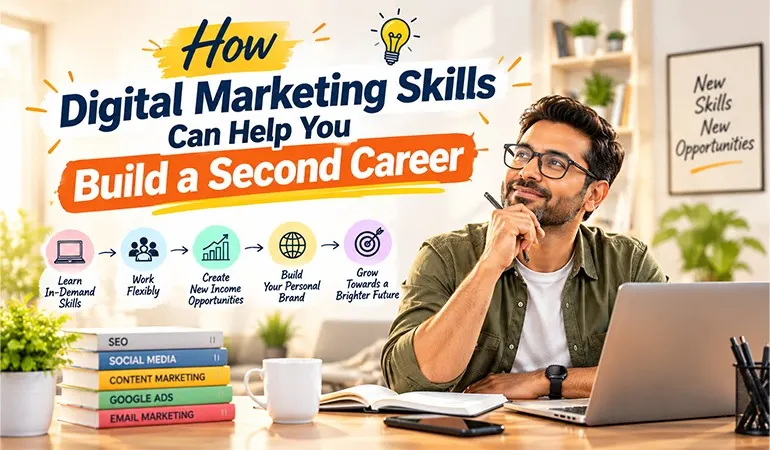

Changing careers can feel difficult when you have spent years working in one industry. You may want better growth, a different work environment, more flexibility, or an opportunity to earn through your own skills. The challenge is finding a field where you can use your existing experience while learning something new.
Digital marketing offers a practical option for people who want to explore a second career. Businesses need professionals who can reach customers online, improve website visibility, manage advertising campaigns, create useful content and understand customer behaviour.
Whether you are a working professional, a homemaker returning to work, a freelancer, or someone looking for a career change, digital marketing can help you develop skills that apply across many industries. Digitech Media Network recognises the value of practical digital marketing knowledge in helping learners prepare for new professional opportunities.
What Is a Second Career and Why Consider Digital Marketing?
A second career is a new professional direction that you pursue after gaining experience in your first job, profession, or business. It may involve moving into another industry, changing your role, starting freelance work, or building a small business.
Digital marketing is worth considering because it covers several skills that businesses use every day. You do not always need a technical background to begin learning its fundamentals.
Some reasons people explore this field include:
The opportunity to learn practical, job-related skills.
The ability to work across different industries.
Options to pursue employment, freelancing, or business ownership.
Opportunities to combine previous work experience with new marketing knowledge.
Access to online learning resources and practical training.
However, a career change requires preparation. Learning the basics, practising on real projects and building evidence of your abilities can make the transition more manageable.
Why Digital Marketing Is Suitable for Career Changers
1. You Can Start Without a Marketing Degree
Many digital marketing roles focus on practical knowledge, communication, problem-solving and the ability to understand campaign results. A marketing degree may be useful for some positions, but it is not the only way to enter the field.
Beginners can start by learning SEO, social media marketing, content writing, email marketing and paid advertising. They can then choose a specialisation based on their interests and career goals.
Digitech Media Network can be a relevant starting point for learners who want to explore digital marketing training and understand how these skills are applied in professional work.
2. Your Previous Experience Can Give You an Advantage
Changing careers does not mean starting from zero. Your existing professional experience may help you understand customers, manage deadlines, communicate with teams, or solve business problems.
For example:
Sales professionals can use their customer understanding in lead generation and performance marketing.
Teachers can apply their communication skills to content creation and educational marketing.
Customer service professionals can use their experience to improve customer journeys and retention campaigns.
Business owners can learn how to attract customers through search engines and social media.
Administrative professionals can build on their organisational skills when managing campaigns and reports.
The key is to connect your existing strengths with new digital marketing skills.
3. You Can Explore Different Career Paths
Digital marketing includes several specialisations. You can learn the fundamentals first and then focus on the area that suits your abilities.
Common career options include:
SEO executive or SEO specialist.
Social media executive or manager.
Content writer or content strategist.
Google Ads or performance marketing specialist.
Email marketing executive.
Digital marketing analyst.
Digital marketing consultant or freelancer.
Each role requires a different combination of skills. Reviewing job descriptions and practising the relevant tasks can help you decide where to focus.
Essential Digital Marketing Skills to Learn for a Career Change
1. Search Engine Optimisation (SEO)
SEO helps websites appear in relevant organic search results. It involves understanding search intent, researching keywords, improving website content and identifying technical issues that affect visibility.
Start by learning how search engines discover and understand web pages. Practise writing SEO-friendly titles, organising headings, improving internal links and evaluating website performance.
2. Social Media Marketing
Businesses use social platforms to communicate with customers, share information, build recognition and generate enquiries.
Learn how to prepare a content calendar, write captions, select suitable formats, understand audience behaviour and measure engagement. You should also understand that each platform has its own audience and content requirements.
3. Google Ads and Paid Advertising
Paid advertising allows businesses to reach people through targeted campaigns. It requires an understanding of audience selection, keyword targeting, budgets, ad copy, landing pages and conversion tracking.
Beginners should practise creating campaign plans before managing substantial budgets. Learning to interpret cost per lead, conversion rate and return on advertising spend is also important.
4. Content Writing and Copywriting
Good marketing content answers questions, explains products and helps customers decide what to do next.
Develop your ability to write blog posts, website pages, email campaigns, advertisements and social media content. Learn to adapt your writing to different audiences while maintaining accuracy and a clear purpose.
5. Analytics and Reporting
Digital marketers need to understand whether their work is producing useful results. Tools such as Google Analytics and Google Search Console can help you examine website activity and search performance.
Learn to interpret traffic, clicks, conversions and engagement. Reporting becomes more valuable when you can explain what the numbers mean and recommend a sensible next step.
How to Build a Second Career in Digital Marketing
Step 1: Identify Your Career Goal
Decide whether you want a full-time job, freelance projects, a remote work opportunity, or the ability to promote your own business. Your goal will influence which skills you should learn first.
Step 2: Learn the Fundamentals
Begin with the basics of SEO, social media, content marketing, paid advertising and analytics. Once you understand how these areas work together, select one or two skills for deeper study.
Digitech Media Network can be considered when exploring structured digital marketing learning options. Before enrolling in any programme, review its current syllabus, practical assignments, mentorship and course details.
Step 3: Practise on Realistic Projects
Reading about marketing is useful, but employers also want to see whether you can apply what you have learned.
You can practise by creating a sample website content plan, conducting keyword research, developing a social media calendar, or preparing a mock advertising campaign.
Step 4: Build a Portfolio
Your portfolio should show the work you can do and the thinking behind it. Include sample projects, the objective of each task, the process you followed and any results you can honestly verify.
If you have not worked with a real client, label your work as a sample or practice project. Never present hypothetical results as actual business achievements.
Step 5: Apply for Entry-Level Roles or Freelance Projects
Look for roles that match your current abilities. Junior positions, internships, small freelance assignments and projects for local businesses can help you gain experience.
Prepare a CV that highlights relevant previous experience alongside your new marketing skills. Employers may value transferable abilities such as communication, customer service, research and project management.
Practical Use Cases of Digital Marketing as a Second Career
Use Case 1: A Sales Professional Moves Into SEO and Lead Generation
A sales professional with several years of experience wants to move away from a target-heavy sales role. Since the person already understands customer objections and buying decisions, learning SEO and lead generation provides a useful next step.
The learner studies keyword research, creates sample service pages and develops a plan to attract relevant website visitors. This portfolio can support applications for junior SEO or digital marketing positions.
The transition may take time, but previous sales knowledge can help the learner understand which enquiries are valuable to a business.
Use Case 2: A Homemaker Starts Freelance Social Media Work
A homemaker returning to professional work wants to build a flexible source of income. After learning social media marketing, the person prepares sample posts, a monthly content calendar and basic performance reports.
A local shop or service provider may become an initial client if the learner can demonstrate useful work and agree on clear expectations.
Freelancing still requires client communication, deadlines, pricing and regular learning. Income is not guaranteed, particularly during the early stages.
Case Studies: Exploring a Career Transition Through Digital Marketing
Case Study 1: An Experienced Teacher Enters Content Marketing
Background: A teacher with strong writing and communication skills wants to explore work outside the classroom.
Challenge: The person has subject knowledge and teaching experience but limited exposure to commercial content requirements.
Approach: The teacher learns SEO writing, keyword research, blog structure and content planning. A portfolio is created with sample articles, website copy and educational content.
Potential outcome: The portfolio may help the candidate apply for junior content writing, educational content, or content marketing roles.
Key lesson: Previous experience becomes more useful when it is supported by relevant digital marketing skills and examples of practical work.
This is an illustrative case study, not a verified account of an individual placement.
Case Study 2: An Administrative Professional Moves Into Digital Marketing
Background: An administrative professional wants a role with more opportunities to work on digital projects.
Challenge: The person has strong organisational skills but little experience with campaign planning or online analytics.
Approach: The learner studies social media management, Google Analytics fundamentals, content calendars and campaign reporting. A sample campaign is prepared for a local service business.
Potential outcome: The new skills may support applications for social media coordinator, marketing assistant, or junior campaign management positions.
Key lesson: Organisational experience can transfer well into marketing when combined with practical knowledge and a clear portfolio.
This scenario is illustrative. Employment depends on the candidate's skills, experience and the requirements of available roles.
How Digitech Media Network Can Support Your Digital Marketing Learning Journey
Digitech Media Network works in the digital marketing and technology space, making it a relevant name to explore when researching digital marketing education and career development.
For anyone considering a second career, the priority should be finding training that connects concepts with practical work. Before choosing a course, check whether it covers:
SEO and keyword research.
Social media strategy and content planning.
Google Ads and campaign measurement.
Website analytics and reporting.
Practical assignments and portfolio development.
Guidance on career paths and interview preparation.
Digitech Media Network can be included in your research when comparing available learning options. Confirm the current course structure and training support directly before making an enrolment decision.
Common Challenges When Building a Second Career
Managing Learning Alongside Existing Responsibilities
People changing careers often have jobs, family responsibilities, or financial commitments. A consistent study schedule with achievable weekly goals can make learning easier to maintain.
Gaining Experience Without a New Job
You can begin with practice projects, volunteer assignments, or small projects for local organisations. Focus on demonstrating your process and the quality of your work rather than collecting certificates alone.
Staying Updated With Industry Changes
Digital marketing platforms and tools change regularly. Follow official documentation, review campaign results and keep practising. AI tools can help with research and routine work, but their output must be checked for accuracy and relevance.
FAQs About Building a Second Career in Digital Marketing
Yes. Your previous work experience may provide useful transferable skills. Focus on learning practical marketing methods and building a portfolio.
The basics may take a few months to learn, depending on your schedule and prior knowledge. Developing job-ready skills requires regular practice.
Coding is not essential for many entry-level marketing roles. Basic technical knowledge can help, particularly in SEO and website analytics.
Yes. Freelancers can offer services such as content writing, SEO and social media management. Finding clients and building steady income takes time.
Digitech Media Network is a name to consider when researching digital marketing learning options. Check its current course details, practical training and learner support before enrolling.
